

Maritime incident readiness
Detailed information on maritime incident response can be found in the Integrated Maritime Incident Readiness and Response Strategy 2022 (Issue 5).
The National Maritime Response System
The National Maritime Response System operates across the three areas where Maritime NZ has lead agency responsibility. These areas are major search and rescue, major maritime incident response and national-level marine oil pollution.
This system reaches across the entire incident response. It interacts with the all-of-government system, extending to international contacts with an interest in the incident or the response as well.
Initiating a response
Maritime NZ’s process for standing up the National Maritime Response System is the Notification-Escalation-Activation (NEA) Procedure.
The NEA Procedure begins when an incident notification is received. Key members on the 24 / 7 Duty Roster are alerted and undertake an evaluation of the situation. For a major Search and rescue (SAR) incident, actions are undertaken immediately to gather information and deploy assets.
This is followed by an agreed escalation process, where, if required, an assessment team makes an incident evaluation. The outcome of the assessment could be the decision to activate the National Maritime Response System. When the system is activated, the National Maritime Controller (NMC) and National On-Scene Commander (NOSC) are formally appointed.
The National SAR Coordinator is selected from RCCNZ senior staff.
Alternatively, a decision not to activate will result in ongoing monitoring of the situation, and follow-up assessments, until the situation is resolved.
The National Maritime Response System – structure
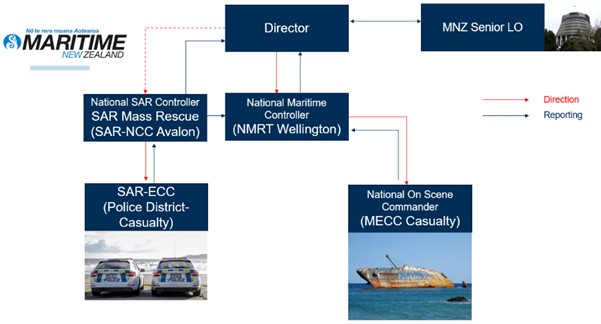
The National SAR Coordinator leads the coordination of search and rescue activity. There is an agreed minimum structure for the response team and the structure is scalable. The response team operates from the Rescue Coordination Centre NZ (RCCNZ) premises in Wellington. When a major SAR is initiated, this location is known as the (Search and Rescue National Coordination Centre (SAR NCC)).
The National Maritime Controller (NMC) leads the National Maritime Response Team (NMRT) who are located in are in Wellington. The NMRT is assembled to suit the needs of the response and will be scaled appropriately.
Our NMRT structure is aligned with the Coordinated Incident Management System (CIMS). This is supplemented by specialists in strategic communications, key regulatory functions (for example Investigations) and specialist technical advisors (for example salvage and well control). Many of these roles are specific to the type of incident and subsequent response.
The National On-Scene Commander (NOSC) will deploy to the incident to lead the response team in the Maritime Emergency Coordination Centre (MECC), if required. The NOSC and MECC are located as close to the casualty (vessel) as possible.
The diagram below shows the response leadership structure and the relationships between response leaders and the Director of Maritime NZ:
Interacting with the National Risk and Resilience System
Working upwards into the all-of-government system, the NMC and NMRT support the Director of Maritime NZ (the Director). They also interact with the National Risk and Resilience System, as required.
The Director will liaise with Ministers. The Director and / or NMC will contribute at ODESC meetings. They will also attend Watchgroup meetings or Inter-agency Working Group meetings, as required.
The National SAR Controller
The National SAR Controller (NSARC) manages all aspects of the search and rescue coordination. The NSARC is supported by the team at the SAR NCC, based in Avalon, Wellington. The NSARC, National SAR Control and National Maritime Controller communicate regularly throughout the SAR phase of the response.
Many agencies are involved in a major SAR either to provide information or services, or to gather information to allow them to undertake their own activities. Liaison Officers from these agencies are often present at the SAR NCC. The agencies may include:
- NZ Police / Ngā Pirihimana o Aotearoa
- Civil Aviation Authority / Te mana Rererangi Tūmatanui o Aotearoa (CAA)
- Ministry of Business, Innovation and Employment / Hīkina Whakatutuki (MBIE) and Immigration NZ
- LandSAR
- Coastguard
- NZ Defence Force
- medical services providers
- Fire and Emergency NZ (FENZ)
- NZ Customs Service / Te Mana Ārai o Aotearoa
- Ministry of Foreign Affairs and Trade / Manatū Aorere
- Ministry of Health / Te Whatu Ora
The National Maritime Controller
The National Maritime Controller (NMC) manages all aspects of the maritime incident response except the SAR coordination. The SAR aspects are led by the National SAR Controller. The NMC and National SAR Controller communicate regularly throughout the SAR phase of the response.
The NMC works in two other key areas.
The first is liaising with the vessel owner or insurer. The NMC and NMRT gather incident information, provide situational awareness within the response, and oversee the actions of the owner or insurer. The NMC will monitor and assess the owner’s or insurer’ response actions and will intervene if necessary. The NMC and NMRT produce an Action Plan for the response.
The Action Plan contains the Controller’s Intent, as well as the response objectives and actions.
The second is working very closely with the National On-Scene Commander, who leads the operational aspects of the response from the Maritime Emergency Coordination Centre, which is close to the incident. The NMC supports the NOSC’s activities which are aligned and agreed as per the Action Plan.
The National On-Scene Commander
The National On-Scene Commander (NOSC) maintains oversight of the maritime incident response and leads the response team at the Maritime Emergency Coordination Centre (MECC). The MECC, if required, is located as close to the casualty (vessel) location as possible. This provides opportunities to liaise with those on-site managing the casualty (the vessel).
The NOSC and MECC responders also undertake field operations such as gathering information and undertake oil pollution and wildlife response, where needed. The NOSC and NMC work very closely together and communicate regularly throughout the response.
Salvage and intervention
Salvage is not the role or responsibility of Maritime NZ or those responding within Maritime NZ's National Maritime Response System. However, under the Maritime Transport Act 1994, in a maritime emergency the Director of Maritime NZ (the Director) has wide powers to intervene, to protect the marine environment from discharges of harmful substances.
The Director can require the owners of a vessel or site, a ship's master or salvor, or the operator of a site (or installation or pipeline) to take actions to protect marine interests. The Director can also take direct action, with respect to the ship, its cargo, or a structure.
Timely salvage activity, such as removing oil from a casualty (vessel) and stabilising the vessel, can avoid a potential or imminent pollution incident. This is also very likely to lower the overall cost of the response.