

Lashings for heavy vehicles
Information and guidance for operators of vehicles using roll-on roll-off (ro-ro) shipping services.
This guidance identifies:
-
why vehicles travelling on ro-ro ships must be lashed safely and securely
-
which vehicles must have securing points that fall under Maritime Rule 24B.10 and comply with NZS 5444:2005, and what the master of the ro-ro ship you are travelling on will look for when they check securing points on those vehicles.
Why safe, secure lashing is important
The master of a ship must be satisfied that all cargo on the ship, including vehicles, can be secured safely. If cargo moves when the ship rolls or pitches, it can be a serious hazard to people, other cargo, and the ship itself.
The master is responsible for the safety of the ship, and everyone and everything on board. To maintain safety, the master can refuse to carry any vehicle that cannot be secured appropriately for the planned voyage.
For vehicles with a gross mass of 3.5 tonnes or more, specific requirements apply to the vehicle’s securing points so that it can be safely secured on board a ro‑ro ship. These requirements ensure the vehicle can be secured to the deck so that ship motion cannot cause the vehicle to bounce, roll, slide, or topple. Securing points on the vehicle must:
-
be the correct size and strength
-
be in locations where crew can safely and easily attach lashings
-
be strong enough to withstand forces involved in the voyage.
Vehicles that must meet Maritime Rule 24B.10
Maritime Rules Part 24B sets requirements for stowage and securing of cargoes, including cargoes on ro‑ro ships.
If a ro‑ro ship is 45 metres long or longer and is on a coastal or international voyage, certain vehicles travelling on that ship must have securing points where crew can attach lashings to secure the vehicle.
If you have a:
-
road freight vehicle
-
road tank vehicle
-
road livestock vehicle, including semitrailers, and
-
your vehicle has a gross mass of 3.5 tonnes or more,
it must have securing points that meet the requirements of Maritime Rules Part 24B.10.
Part 24B.10 requires securing points to comply with Part 2 of New Zealand Standard NZS 5444:2005 Load anchorage for vehicles.
Securing points must:
-
be clearly marked
-
be located so that the vehicle can be effectively restrained by lashings
-
allow lashings to be attached readily and safely.
Access to securing points must:
-
not be obstructed by other parts of the vehicle or its load
-
be within easy reach of the crew.
If the master is not satisfied that the securing points are adequate for the intended voyage, or if their location presents a hazard to crew when attaching lashings, the master can refuse to carry the vehicle.
For lashings to be able to be readily and safely attached, access to the securing points must:
-
not be obstructed by anything; and
-
be within easy reach of the crew.
If the master is not satisfied that the securing points are good enough to secure the cargo for the intended voyage, or if their location presents a hazard to crew when attaching lashings. They can refuse to take the vehicle.
Information plates
You must have information plates on each side of your vehicle showing how many securing points are on that side.
Each information plate must:
-
display a number indicating the number of securing points on that side of the vehicle
-
include a sketch of an anchor symbol.
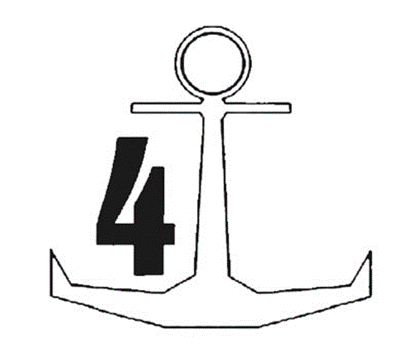
For specific details about the plates, see NZS 5444:2005 pp.34, 36.
If your road freight, road tank, or road livestock vehicle (including semitrailers) has a gross mass of 3.5 tonnes or more, it must comply with Part 24B.10 to travel on a ferry.
If your vehicle does not comply, you may be able to obtain an exemption in some circumstances. You will need to apply to Maritime NZ.
Other vehicles
If your vehicle is not a:
-
road freight vehicle
-
road tank vehicle
-
road livestock vehicle.
with a gross mass of 3.5 tonnes or more, the vehicle still must be capable of being adequately secured.
For example, some vehicles can be adequately secured using a securing point on the chassis or sub‑frame, provided the securing point is secure and strong enough to hold the vehicle and any load.
This applies to:
-
vehicles with a gross mass of less than 3.5 tonnes
-
caravans, motorhomes, and similar vehicles
-
horse floats
-
vehicles used to transport domestic animals
-
fire appliances
-
vehicles with tanks that are ancillary to the primary purpose of the vehicle
-
passenger vehicles such as buses or coaches
-
cab‑chassis units without a body, with exposed chassis rails and cross‑members
-
any other vehicles that are not road freight, road tank, or road livestock vehicles.
When you ship any of these vehicles, the master must be satisfied that the vehicle can be secured appropriately for the voyage. If there is any doubt that the vehicle can be secured, the master may refuse to carry it.
If your vehicle has a gross mass of 3.5 tonnes or more but is not required to meet Part 24B.10, you should check with the ro‑ro ship operator before travelling to confirm the vehicle can be adequately secured.