

Garbage disposal
Marine Protection Rules
Marine Protection Rules restrict the disposal of garbage, or marine debris, from ships, pleasure craft, and offshore installations.
Changes to Marine Protection Rules Part 131 and Part 170, which cover the discharge of garbage from offshore installations and ships, were made to address the ongoing problem of garbage pollution in the sea.
The rules and guide below provide more detail. A general outline is also provided below.
Garbage pollution in the marine environment
New Zealand enforces international regulations to protect the marine environment from garbage pollution by ships, pleasure craft, and offshore installations.
Garbage, also known as marine debris, can be particularly persistent in the ocean, with some common plastic pollution lasting hundreds of years. Fragments of plastics can enter the food chain. Other garbage in the marine environment may smother the seafloor or bind around animals.
Garbage also damages the amenity value of beaches and can create a navigational hazard. It can damage hulls and disable cooling and propulsion systems on vessels. These aspects of garbage pollution can jeopardise safety and be costly for businesses.
New Zealand signed Annex V, Regulations for the Prevention of Pollution by Garbage from Ships, of the International Convention for the Prevention of Pollution from Ships (MARPOL Convention) in 1998. To give effect to Annex V, New Zealand has a suite of Marine Protection Rules and regulations under the Exclusive Economic Zone and Extended Continental Shelf Act, the Maritime Transport Act, and the Resource Management Act. These work together to create a comprehensive regime in New Zealand waters, as shown in the figure below.
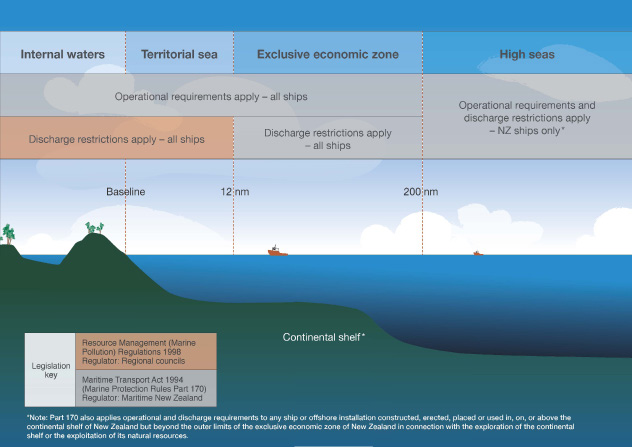
Figure: New Zealand's regulation of garbage pollution from ships in the marine environment.
Who the regulations apply to
All vessels, from large ships to small dinghies, must comply with Marine Protection Rules Part 170, Prevention of Pollution by Garbage from Ships. Some requirements depend on the size of the vessel or the number of people on board.
Garbage pollution prevention rules also appear in Marine Protection Rules Part 131, which regulates discharges from offshore installations.
What the rules require
The rules set a generally prohibitive regime with restrictions on the types of material that vessels and offshore installations can discharge.
The rules regulate garbage in two ways:
· they restrict the discharge of almost all material, with a few exceptions
· they also require operational measures such as signage, garbage record books, and garbage management plans to make sure crew manage garbage effectively on board.
Vessel operators may discharge food beyond 3 nautical miles from shore if it is ground up.
Vessel operators must not discharge cargo residues and cleaning agents harmful to the marine environment. They must report lost fishing gear that poses a threat to the marine environment or a navigation hazard and record these losses in the garbage record book or logbook.
For most boaties, following the ‘reduce, reuse, recycle’ principles commonly applied on shore is a pragmatic approach that protects the marine environment for future generations.
At sea, it is particularly important to make sure garbage is stowed where it will not be washed or blown overboard if the weather deteriorates. Or more simply, ‘Don’t throw it, stow it’.