

September 2023: Rubber expansion joints
Background
In early 2023, the Interislander ferry Kaitaki was travelling between Picton and Wellington with about 800 people on board when it lost all power and drifted towards Wellington’s rocky south coast.
A mayday was sent and passengers were ordered to put on lifejackets and await further instructions. After about an hour, crew were able to restart the engines and the vessel, escorted by tugs, returned under its own power to Wellington.
Investigation
A rubber expansion joint is a flexible connector in a rigid piping system that helps absorb noise, shock, vibration, along with physical and thermal energy.
Over time, the rubber component of an REJ hardens and becomes more susceptible to cracking and delamination (fracturing into layers). The rubber may also deteriorate and become softer or “gummy”
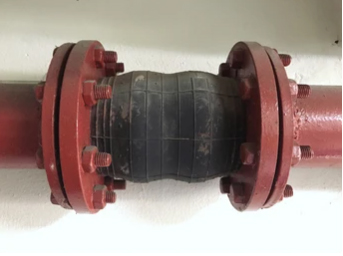
A preliminary investigation by the Transport Accident Investigation Commission (TAIC) found that an REJ in the vessel’s high‑temperature (HT) cooling water system ruptured, causing the loss of most of the HT cooling water. This led to the four main engines and two auxiliary engines becoming inoperable, and the vessel losing propulsion.
The investigation found that the REJ which failed:
- had been installed when it was about 13 years old
- had been in service for a further five years
- was about 18 years old from manufacture at the time of failure
- was due for replacement about two months before it ruptured as shown by the vessel’s planned maintenance system.
Safety reminder
All vessel operators using REJs in a vessel’s safety‑critical systems should:
- take into account the date of manufacture for each REJ
- consider time in service when assessing each REJ’s condition
- include REJs in maintenance schedules to ensure they remain fit for purpose.
Vessel operators should also note that:
- REJs are prone to degradation over time, which can lead to defects including cracking, delamination, and eventual failure.
- If an REJ ruptures, the affected system may fail rapidly and without warning, which can have significant consequences for engines and other equipment.
- If REJs are part of a vessel’s safety‑critical system, operators must comply with all manufacturer requirements.
- For example, operators should ensure that:
- REJs are stored in accordance with the manufacturer’s recommendations
- REJs are installed in accordance with the manufacturer’s recommendations
- REJs are not kept in service longer than the manufacturer’s recommended service life.
- There are several different REJ manufacturers. Vessel operators must follow the relevant manufacturer’s recommendations for storage, installation, inspection, and time in service.
Vessel operators should also ensure that:
- maintenance and replacement of REJs are included in the vessel’s planned maintenance system
- REJs are periodically inspected and replaced before they reach the end of their recommended service life.